Pão com Dentes
This is a page for people who want to make their own sourdough bread, but are complete beginners and don't know where to start. The name 'Pão com Dentes' (literally, 'bread with teeth') is a Portuguese expression for eating bread on its own, without butter, jam or any other spreads or toppings. This is my favourite way to eat bread.
I am not a professional baker nor sourdough expert. This website is a reflection of what I've learnt after a couple of years of baking bread and what I found works for me. Questions, comments or suggestions?
Sourdough starter
To make sourdough bread, you'll need a sourdough starter. This is a culture of natural yeasts maintained in a mixture of flour and water, a living creature that you need to feed and keep alive to make bread with.
Here I'm going to assume you have your own sourdough starter already, possibly because your amazing friend Bárbara hooked you up with some. If you don't, there are plenty of resources online to help you make your own sourdough starter. The only ingredients you'll need are flour and water, though making a starter from scratch also requires time and patience, and some people find it hard to get it to mature (which takes at least 5-7 days; mine took considerably longer). It's easier to get some ready-to-use starter from someone else. But if that's not available to you at the moment, try making your own: here's another recipe for it. (You can also get creative!)
I'd recommend storing your starter in a ~1l container with a lid in the fridge. I use a glass jar, but a tupperware will do. This volume is enough to give room for your sourdough to grow, but small enough not to take too much space.
Now that you have your starter in its new container, you'll need to keep it from going bad by feeding it every once in a while. If you keep it in the fridge, the yeasts will multiply and eat more slowly than if you keep it outside (they multiply quicker in warmer environments), so you'll only need to feed your starter a couple of times a week. These timings may differ if you don't have a wheat starter like I do, but they shouldn't be too far off.
Always feed your starter with the same type of flour your starter is made of, wheat in my case. I discard part of the starter (about a third to a half, so that the jar I keep it in doesn't overflow) and add one cup of wheat flour and half a cup of water. Some people add more water, but the thicker your starter, the less often you'll have to feed it (I've read somewhere the yeasts multiply faster in more liquid environments).
I feed my starter with wheat flour type 1050, which I can find in Germany, but types 550 or 812 will do too. In Portugal or France you can use wheat flour type 55 or 65. As when making your bread, look for a flour that has wheat as its only ingredient (no added leavening agents). Here's how I feed my wheat sourdough starter:
You'll want to take your sourdough starter out of the fridge and feed it the morning before you make your bread dough (say, Friday morning if you are making your dough on Friday evening to bake your bread on Saturday). You can also take it out of the fridge a day earlier, but make sure you feed it some 8 to 12 hours before you make the dough. It will need to be active and bubbly for you to make bread with it. I've heard someone describe it as the yeast eating and then farting: active means lots of gas bubbles. Here's what it should look like:
Ready? Let's make some sourdough bread!
Sometimes, if you forget to feed your starter, you'll notice that a dark layer, often with liquid, forms on the surface. This just means your starter is really hungry. If this happens, make sure to remove this dark layer and any liquid before you feed it. If you don't, your starter will get a slight smell of alcohol and won't be very good to bake with. If you have issues with your starter, check this troubleshooting website. It can take some time to get your starter to a bubbly stage: be patient!
If you don't make bread regularly, there's no point keeping your starter in the fridge, as you'll need to keep feeding it with flour and discarding part of it, which is wasteful. When I go on holiday, especially if for longer than about 5 days, I simply put my starter in the freezer, and you can do this too if you are only going to bake once or twice a month. In this case, make sure to remove your starter from the freezer 2 or 3 days before you make your bread dough. As soon as the starter has defrosted, give it some food and keep it outside. It will be back to normal in no time.
You can use your starter for a lot more than just baking sourdough bread. You can make fantastic sourdough pancakes, focaccia, etc).
How to make bread
To make a basic bread, you’ll need flour, water, salt and yeast, such as natural yeast or sourdough starter. For now, forget all other ingredients. When done right, bread made with only these four ingredients will be rich and delicious. You don’t need anything else.
The recipe I use to make my sourdough bread is the No-Knead Everyday Sourdough from Baked, the blog. It’s very easy to make (though it takes time – any good sourdough bread does) and gives great results. You’ll want to start the day before, but don’t be scared: there’s only about 15-30 minutes of actual work in the 24 hours or so you’ll be making your bread. The recipe takes time because the yeasts in the sourdough starter need time to do their job, that is, to multiply, to produce air bubbles and to give flavour and volume to your bread.
Ingredients and equipment
To make your bread dough, you'll need:
500g of flour (+ some 50g or so more for your work surfaces)
350g of water
2 teaspoons of salt
50-60g of active sourdough starter
For the flour, I’d recommend starting with regular wheat flour (type 55 or 65 in Portugal or France, 550 in Germany, strong flour in the UK). Pick a wheat flour that does not have any added chemical leavening agents: you want a flour that only has wheat in it. Mixing other flours will improve the flavour of your bread, but many of them will tend to make your bread heavier and the dough drier so I would recommend starting with only regular wheat flour. Once you feel more confident about bread baking, you can try mixing in other types of flour, such as whole wheat or rye flour.
(A side note for anyone having trouble finding bread flour at the moment. In Germany, you can get the flour type 405 (pastry flour) and 812 or 1050 flours (high-gluten bread flours): just mix the two types in your bread to get a flour with a gluten content similar to the type 550 flour. You can also find flour online. In France, you can get amazing flour online from this mill in Alsace. In Portugal, I’d recommend looking for T65 flour. You can usually find Espiga T65 flour in supermarkets, but if that fails, check the bio shops or ‘lojas a granel’, they likely have even better quality flour than what you can find in the supermarket. In my home town, Leiria, there is even a traditional flour mill but the opening hours are rather reduced so I have not yet managed to try that flour.)
Aside from the ingredients mentioned above, you’ll need equipment: scales, a bowl, spoons, a soft scraper, a whisk or a fork, a tea towel, a large plastic bag and, very important, a heavy pot with a lid, like a Le Creuset cocotte/dutch oven or similar, about 22 cm in diameter (I use a 20 x 25 cm oval pot). The heavy pot is where you’ll bake your bread so you need to make sure both the pot and lid can go in the oven at very high temperatures (250 to 260 °C). If you don’t have one, you can improvise: I’ve successfully baked bread in Portugal using a deep Pirex dish with a shallow one as a cover. You could try a regular pot, provided it is oven safe, though the heavier the better. The idea is to have something that will keep the heat and humidity, which will help your bread rise in the oven and get a nice crust.
In the baking video below, I also use a water spray, but don't worry if you don't have one. Spraying water helps the bread form a nice crust, but it's not strictly necessary.
If you can't be bothered watching videos and would prefer reading a recipe, go ahead and head to Baked, the blog and follow the recipe there. If you'd like to see what the dough is meant to look like at the various stages, or like to follow the baking process with videos, read on and watch below.
Making the bread dough
To start making bread, the first thing you'll need to do is to remove your sourdough starter from the fridge (say, Friday morning) and feed it with some flour and water (remember to discard part of it). It will be bubbly and active a few hours later and ready for bread baking.
You should make your bread dough the evening before you bake your bread (say, Friday evening), as it takes 8-14 hours for your bread to rise. Here's how to make your dough:
Proofing
When you get up the next day (say, Saturday morning) you'll do the second part of the bread. The original recipe from Baked, the blog states that you need to let your bread rise for about 8 to 10 hours but I find it can take a lot longer. The exact timing depends on what flour you use and, mainly, on the temperature of the room your bread dough is in. In the winter, in a cold kitchen, it can take up to 14 hours for the dough to be ready. In the summer it takes a lot less than that. It takes a bit of practice to find out when your dough is ready. I explain what to look out for in the video below, where I show you how to make the second part of the recipe:
Baking
Once the bread has finished proofing and your oven is nice and hot, you can bake your bread. Your bread will be in the oven for about 40 to 45 minutes total, but at different temperatures: 10 minutes at 250-260 °C (remember to pre-heat for 20-30 minutes, with your dutch oven inside), 10 minutes at 210-220 °C, and then 20-25 more minutes at 180-200 °C, depending on the colour of your bread after the first 20 minutes. See how it's done in the third and final bread-baking video:
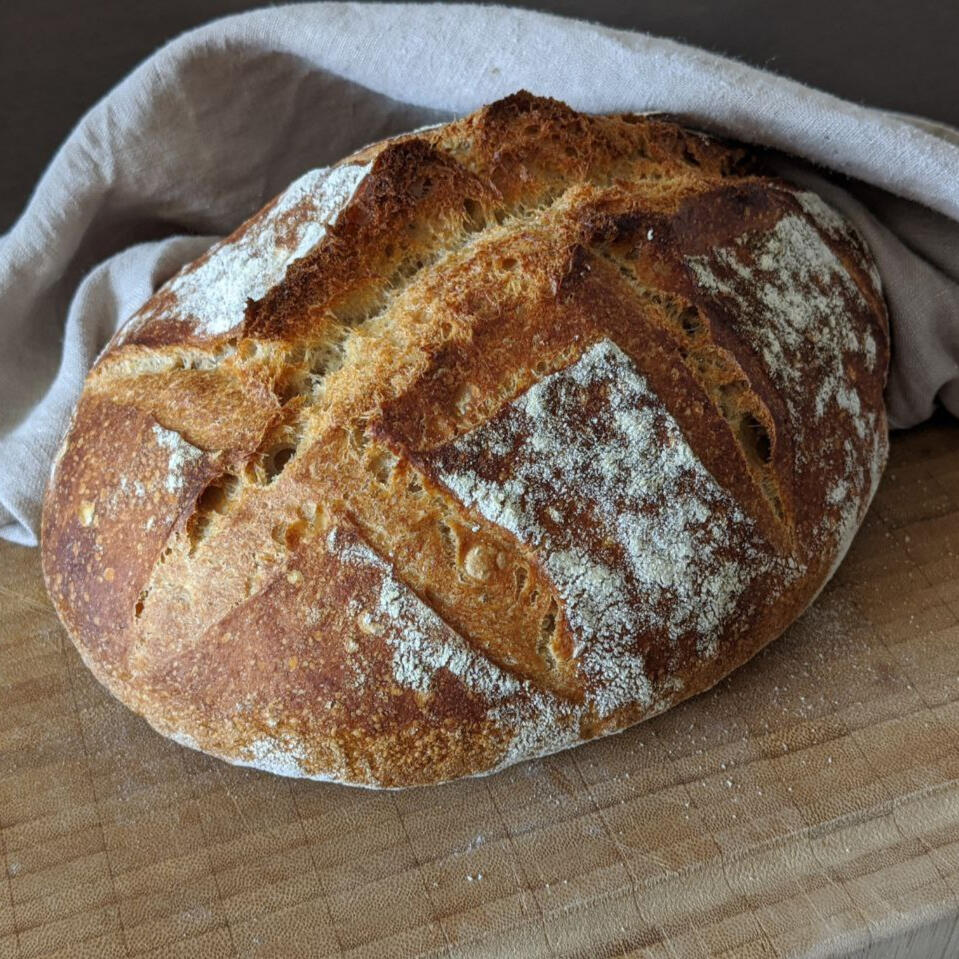
Congratulations! You've made sourdough bread. Here's what it looks and sounds like when you take it out of the oven (increase the volume for this one):
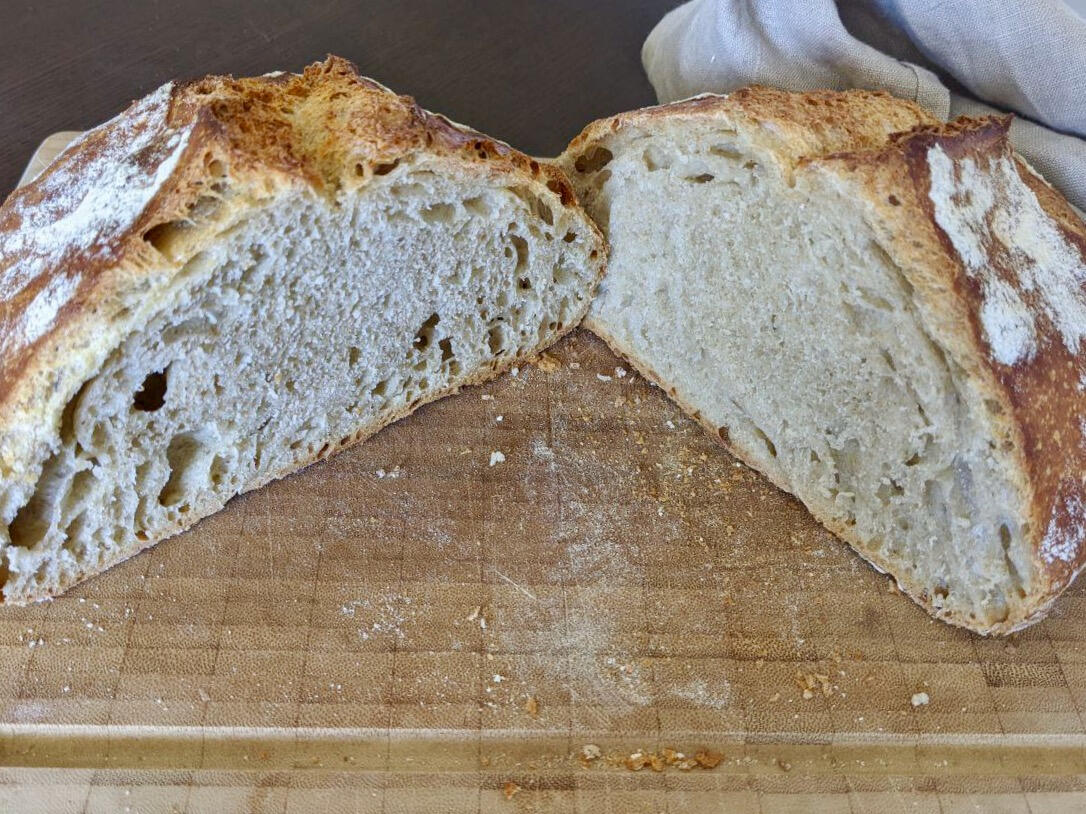
And here's what it looks like on the inside (it may have fewer or more holes, depending on the flour you use). Make sure to let it cool down completely before you slice it. Enjoy!